Author: Chloe Smith
Govan Community Project has been shortlisted for several awards.
The charity has been shortlisted for a Community Inclusion Award at the Inspiring City Awards 2025. The ceremony takes place on 8 September.
The organisation is also a finalist in the Glasgow Business Awards in the category of Community Wealth Building. The ceremony will take place on October 2.
Community fundraising volunteer, Ayoub Stitou, has been shortlisted for an award in the Social Enterprise Awards Scotland.
Ayoub is nominated for Social Enterprise Volunteer Champion of the Year. This award recognises an individual volunteering with a social enterprise that goes above and beyond to make a difference.
The winners will be announced in November.
Some members of our Women’s Group recently headed to the Highlands for a trip to Trees for Life. The organisation is helping to rewild the Scottish Highlands, and aims to close the gap between people and nature. We asked Women’s Group member, Nawal, to write about her experience.
I recently had the chance to go on a beautiful three-day trip to Dundreggan. It was a trip just for women, which made it feel extra special and safe. As someone who is still quite new to Glasgow, this experience was a wonderful way to explore a new part of Scotland, connect with nature, and meet amazing women from different backgrounds.
During the trip, we learned how to plant trees and were shown how they are cared for over time. We also talked about the importance of trees and plants, how they help the climate, and how looking after the environment is a way of showing love to the Earth. It was inspiring to hear how deeply connected some people are to nature and how much passion they have for protecting it.
We did so many activities together — from walking through the forest to trying to get into a cold lake (which was both scary and fun!). It felt like every day brought a new experience. I loved the peaceful surroundings, the fresh air, and the feeling of being far away from the noise of daily life.
One of the best things about the trip was the chance to connect with other women. We shared stories, supported each other, and created memories that I will never forget. This trip reminded me of the strength that comes from being in a supportive community and the healing power of nature. It was truly one of the most beautiful and meaningful experiences I’ve had since arriving here.

At Govan Community Project we are deeply concerned about the recent Supreme Court ruling and the subsequent guidance from the Equalities and Human Rights Commission (EHRC), both of which have raised significant questions about the interpretation and application of sex-based rights under UK law.
We want to be clear: Govan Community Project stands in solidarity with transgender and gender-diverse people. Trans women are women. Trans men are men. Non-binary people exist. We also recognise the existence and rights of intersex people, who are frequently excluded from public discourse.
As a human rights organisation working with people seeking asylum and refuge—many of whom have experienced profound trauma and systemic exclusion—we understand how important dignity, recognition, and safety are to the lives of those we support. Our services have always operated, and will continue to operate, on the basis of self-identification. This principle is core to our values of respect, autonomy, and inclusion.
We understand that transgender people are protected under the Equality Act 2010, including through the protected characteristics of gender reassignment and sex. We will continue to provide services that are inclusive of all people, and we reaffirm our commitment to ensuring that everyone accessing our support feels safe, seen, and respected.
We are proud to offer inclusive opportunities in our workplace and across our programmes. This includes welcoming gender diversity within our staff team and ensuring that our women’s and men’s groups are open to participants based on their self-defined gender identity.
We are particularly concerned about the potential chilling effect these legal developments may have on public and civic life for transgender and gender-diverse people—including those seeking asylum, for whom access to safe, affirming spaces is already limited. At a time when trans communities face rising hate crime and marginalisation, we believe it is vital that organisations like ours speak up in support of their dignity and rights.
Our approach is grounded not in politics, but in compassion, community, and international human rights law. We acknowledge the concerns our staff and community members have raised and reaffirm our role as an ally to the LGBTQIA+ community. We will continue to learn, listen, and stand beside all those who face systemic discrimination, while focusing on what we can do: provide safe, inclusive, and life-changing support.
Now more than ever, we call on decision-makers to uphold the fundamental rights of all people—to be treated with dignity, to live without fear, and to exist as their true selves.

This Mental Health Awareness Week (12-18 May) the theme is ‘Community’. We want to use this week to highlight the power and importance of community.
Being part of a safe, welcoming community is vital for our mental health and wellbeing. Govan Community Project runs many community groups, which allow people to come together to talk, share stories and ideas, be creative and make new friends.
We spoke to Brian*, a long-standing GCP volunteer, about the difference being part of our community made to his life.
Brian was first housed in Govan in 2018 during his asylum claim, at which time he had already been waiting for three years on the outcome. He said: “It was a very hard time for me and I was feeling very low. I wasn’t feeling connected to any other people living in Govan.”
Before Brian sought refugee status in the UK, he had been a student in Gambia and was studying for a Higher Teaching Certificate (HTC). His dream was to be a doctor, and told us his life was “full of promise.”
But the many years waiting on the outcome of his asylum claim took its toll, he struggled to concentrate on anything, and was left feeling stressed and isolated. Brian said that it was hard to make friends, he added: “You don’t know who to trust in your community when you’re in the asylum system. It is hard to find people that you can trust and everyone is feeling very paranoid to talk about their cases for privacy reasons.”
A turning point for Brian came when he became a volunteer for the Govan Community Project Food Bank during lockdown. He got invited to join the Food For All Group and became one of the first ever members of the group. Brian has been an incredibly valued member of the group for the past four years.
During this time, Brian has gained more confidence and trust in his community. He said: “Since joining the group I have felt more confident. I have met new people and they have been very helpful. I’ve been homeless during different periods and I’ve been able to go to group members for support. Now I have people I can rely on and ask for help with any issue.”
Before joining the Food For All Group, Brian had no one to share his story with. However, since spending time with other group members he has been able to experience support and also make positive changes for his other community members. Brian is very dedicated to improving life for his community.
Since finally receiving his refugee status in 2024- nine years after his initial application- Brian has been able to return to his studies. He is now studying medical administration. He said: “Even if I ever get a job, I will find the time to volunteer with Govan Community Project on my day off. [It’s about] making improvements for other people…it’s about making positive change.”
*name changed to protect anonymity

Over the years, GCP has built up a following and lots of collaborative connections through the platform of X (previously Twitter), which has helped amplify our messages and enabled us to share important information. However due to many of the changes happening on this platform, both technologically and values-based, we are taking the decision to no longer use this platform for the sharing of information.
Some of the changes are making communication on this platform less effective, and many of those we engage with are also no longer using the platform, but our main rationale for choosing to no longer use X is because we no longer believe the platform is in line with our values of social justice, equality and anti –racism. We have seen a huge increase in the amount of posts allowed on the platform which are spreading misinformation and messages encouraging and promoting discrimination, misogyny, and hate speech. We saw in the summer months the devastating impact the use of social media had on spreading misinformation that incited racial violence. The platform now also offers less protection for us as users from online abuse.
We will keep our account open for a while, but will no longer be regularly using it as a platform for posting information. We will post occasionally a reminder to our followers to connect with us on other platforms.
Zeinab* found Govan Community Project when she moved to Cardonald in 2017. Here she shares her story, and explains the impact attending our Women’s Group has had on her life.
I came to Scotland in 2011 from Afghanistan with my two young children to join my husband who was working here. In the first few months I was busy looking after my children and making my home, but after a few months I started to miss my family, there was no internet in Afghanistan for us to call, I started to feel alone. I had three friends, they were the wives of my husband’s friends, they were all I had. I went to college to learn English. I had to start right from the very beginning, from ABCs, but then I was pregnant with my son, and then my daughter and I didn’t have time to attend college. We moved around from Ibrox to Govanhill, and then in 2017 we moved to Cardonald. When I moved to Moss Heights, my neighbour told me about the community flat and GCP, she said they were friendly and they would help me.
When I first came to the Women’s Group I was very afraid, I was afraid to leave the house by myself or with my children, I was afraid to get lost or for something terrible to happen to me. Everywhere I went, I went with my husband and I was very alone and scared. It started with the walking group, every week we would go out and walk around the park, the women would walk and then we would share fruit and talk. Going outside was good for me, before I had depression, all I could think about was my family. But I learnt that going outside and walking wasn’t scary, it was good for me. Then we learnt how to cycle, it was a class just for women, after two lessons I could cycle. I had never had a bike before, in Afghanistan women are not allowed to ride bikes, I never had a bike as a child. So when I learnt how to cycle I felt total freedom, I felt the best, I can cycle – I can go anywhere. They said if I could learn I could have a bike, so then I got a bike from GCP bike library.
After learning how to cycle I wanted to learn how to drive, I felt if I could learn to cycle I could learn anything. Friends at Women’s Group told me I could do it, they sent me the app and encouraged me to try. My husband said the test was very difficult, I might not pass. I passed for the first time. Then I passed my practical test and I could drive. All of this happened when I joined the group, before I joined I felt very weak, unable to do anything. In my country the men say that women are just to stay in the home, they can’t do anything. But coming to this group I met strong women who worked, who went outside, I felt like I could do anything. It’s important for me to show my children to be brave, not to be scared.
I have learnt and tried so many new things through this group, we have learnt new sports and activities, I have seen so much of Glasgow through this group and trips. I tell everyone to come to this group, I tell my friends and my neighbours. Two years ago I said I wanted to work here, I had no experience but I wanted to learn. I started to volunteer for an hour at the Women’s Group, I sign people in and I welcome them to the group. Last year someone new came with her husband, she was very nervous and couldn’t speak English, her husband was worried about her being at home alone all the time. I met her, and I welcomed her to this group. I like getting to be the person who meets new people, when I see new people; I know them, I feel that.
There are a lot of refugee women at home alone, they don’t know how to start or how to get confidence, I tell them to come here, I like being the person to meet them now. Through this group I have met lots of close friends, neighbours, they give energy and inspire women. This group is like a family, GCP is my second home, I come every Friday and I love this community.
*name changed to protect anonymity

Govan Community Project has had a busy month of networking, with several opportunities to raise issues with both the Scottish and UK Government in relation to funding, child poverty, impacts of policy on our organisation and the ongoing impact of immigration policies on individuals and communities.
Traci Kirkland, GCP Head of Charity told us more:
“I attended an event in relation to child poverty organised by the Robertson Trust where there was the opportunity to raise concerns with the First Minister around the restrictions No Recourse to Public Funds causes with initiatives in place to tackle child poverty.
I was at an event organised by GCVS, where a gathering of third sector representatives met with MPs to raise issues and concerns they would like them to consider when spending reviews are taking place at Westminster – as you can imagine there were many issues raised including the cost of living crisis, the impact to charities of the change in national insurance employers contribution, the two child benefit cap, immigration policies including the right to work, which was raised by GCP and others present. We were disappointed that only two of the local MPs engaged with the event, however it was still helpful to have the opportunity to raise these issues.
At The Gathering 2025 in Edinburgh, an event organised by the Scottish Council for voluntary organisations, I was honoured to be one of four charity representatives invited to join the First Minister, John Swinney, on stage for a dialogue on issues and challenges being faced by the voluntary sector. In his opening remarks, the First Minister acknowledged the valuable contributions and levels of support provided by the voluntary sector and highlighted that the timescales under which the Scottish Government provides funding decisions and the short-term nature of funding agreements were not good enough. He also spoke about the Scottish Government’s awareness of the challenges facing the voluntary sector in relation to ongoing rising costs.
Following on from this, I took the opportunity to raise the concern shared by GCP and many other organisations that there is a disconnect with Scottish Government awards, which have remained static, yet organisations are expected to meet rising staffing and operational costs. I urged the Scottish Government to not only review funding agreement terms, but also the amounts awarded and use its influence to engage with other large funders on the importance of this issue.
We have also been working collaboratively with colleagues at Glasgow University on sharing learning with trainee GPs on the health inequalities experienced by community members and a huge thank you goes out to our community members who came along and shared their views and experiences with the GPs, providing invaluable input to their ongoing learning. Thanks to Dr Anna Black and her colleagues for inviting us along.”

The Home Office has announced it will extend the ‘move-on’ period of time given to newly granted refugees from 28 days to 56 days.
Govan Community Project Head of Charity, Traci Kirkland, welcomed the news.
“GCP are delighted to hear the news that the Home Office have extended the move-on period for newly granted refugees to 56 days, something that many organisations across the sector have been campaigning for for a long time. We hope this will see less people being forced into destitution as they take the next steps in rebuilding their lives in our communities.
“We note however that this is currently announced as a ‘time limited trial’ and we would urge the Home Office to make this a permanent policy change, to ensure that all refugees are provided with a more appropriate timescale to access their rights and entitlements, reducing the risk of homelessness.
“Whilst this is a hugely positive step, it does not sit in isolation of other policy and process and individuals and families will only fully benefit from the increased timescale if other barriers are reduced, such as ensuring access to e-visas and notice periods are received within the correct timescales, in the right order.”

The Scottish Government announced yesterday (Monday 19 August) it will scrap plans to provide free bus travel for people seeking asylum. Our Head of Charity, Traci Kirkland, reacted to the news.
“We are absolutely devastated at the news of the scrapping of the plans for a bus travel scheme originally announced in the Scottish Government’s 24/25 budget plans.
This scheme had offered a glimmer of light in the limited support New Scots receive, enabling them to access crucial support services to rebuild their lives in Scotland. The cost of public transport is an extreme financial barrier to those we support, forcing vulnerable individuals and families to make decisions between basic needs of food or attending important appointments and it increases the impact of social isolation.
The scheme was also going to take some of the pressure off third sector organisations who understand the importance of travel support to those living on £7 a day or less, and were subsidising travel costs from their already limited resources.
We call on the Scottish Government to rethink this budget cut and fulfil what was promised. This investment should have been viewed as a preventative spend- if other support is more accessible this would actually take some pressure off the public purse, not add to it.”

Ivan joined the Food for All Group when GCP opened up the group to new members at the start of the third round of funding in June 2023. He had held a high profile position in football management at an executive level, before having to claim asylum in the UK in 2021 with his wife and two children.
Ivan shared how at the time of joining the Food for All project, he was still waiting for his last interview with the Home Office. This time was characterised by a lot of anxiety and a sense of hopelessness regarding the future. Being part of the project provided a structure and routine to keep to which, along with the opportunity to contribute his skills and share his experiences with others in the asylum process, helped to improve Ivan’s mental health.
“When I read the advert for the role [with the Food for All Group] it really spoke to me,” said Ivan. “It’s something that I wanted to be part of, to make the change I wanted to see. Joining the group and making a contribution was a very good opportunity for me, because I am not being allowed to work or do anything. [But being part of the project] gives you hope in life that at least you can still make a contribution to the community.”
Ivan found there were also other benefits of being part of the project, including learning how things are done in this country, and support with integration. The Food for All project was also the first opportunity Ivan had to share his experiences with other people with lived experience of the asylum process.
“It has changed the way I look at things because I thought I was in the worst situation, but I’ve seen people who are having tougher challenges than me. Sometimes you can think that you’re the unlucky one. And despite this, I’ve seen team members who are going through the toughest situation, but they still have the opportunity to come out and present themselves.”
Three years on from arriving in the UK, Ivan and his family have now happily been granted Leave to Remain. Ivan had anticipated that, once his immigration status had been confirmed, he would continue his career in football management. However, as a result of working with the Food for All Group, his career goals have changed and he now hopes to continue to raise awareness, advocate for and bring change for New Scots.
“I have discovered how much my contribution is needed here; I feel really motivated now,” said Ivan, who is about to embark on a degree in Common Law at University of Glasgow, while continuing as part of the Food for All Group. He added: “I’ve got something to give. I’ve got some kind of belonging.”

We are horrified by the scenes of coordinated violence seen throughout the UK over the weekend targeting refugee, migrant and Muslim communities.
To those in our communities across the UK who have been targeted or are living in fear, we send a message of hope, strength and solidarity. We also send a reminder that our communities have demonstrated time and time again that refugees are welcome here.
To the UK government we send a message that you need to take responsibility and you need to do more to heal communities not divide them, including holding the media to account for their role in inciting division in our nation.
Govan Community Project has signed a letter along with over 240 organisations to call for communities and the country to be brought together for a different way forward- one that’s compassionate and united. This must be a turning point. Find out more about the Fair Begins Here campaign.


Traci Kirkland, Head of Charity at GCP, outlined her message to the new government in our latest newsletter, read below.
“This month we have seen a new UK Government, whose slogan was ‘change’. Here at GCP we really hope that change includes a realistic and compassionate reform to immigration policies, moving away from the hostile environment towards building an inclusive society where everyone’s contributions are recognised, valued and welcomed.
We stand alongside partner agencies we work with in the migration sector and all of our community members to make an appeal to the Prime Minister and his new government to make rebuilding the immigration system one of their big changes. To this end we continue to be part of the Fair Begins Here campaign from Together for Refugees. Polls increasingly show that the majority of the nation see migration and diversity as a huge benefit to our communities and our economy. They agree that the current, dehumanising system is broken beyond repair and does not represent the views of most of the country or how we want other nations to see us.
We were delighted to see the Prime Minister scrapped the inhumane Rwanda scheme on his first days in office. We would now urge the new government to work with and learn from those in the sector, and most importantly, those with lived experience, to co-design a system which is fair and based on humanity. We want to see safe and legal routes for vulnerable individuals and families who seek sanctuary from the social injustices which are happening globally. We would also ask that the government recognises the level of harm and toxicity caused by the use of dehumanising language when talking about migration and takes steps to address this.
“We are way more powerful when we turn to each other and not on each other, when we celebrate our diversity… and together tear down the mighty walls of injustice.” Cynthia McKinney
We ask the government to let people live with choice and dignity, through scrapping policies such as No Recourse to Public Funds, lifting the ban on working for those in the asylum process and scrapping benefit caps which keep families in poverty.
At a local level we bid a fond farewell to our outgoing MP Chris Stephens who stood firmly alongside our community in opposition to hostile immigration policy and thank him for all of his support. We extend a warm welcome to Dr Zubir Ahmed as our new constituency MP in Glasgow South West. We ask Dr Ahmed to stand in solidarity with our community and push his parliamentary colleagues to look beyond the numbers and the reports and truly engage with and listen to people at community level when looking at solutions for the broken immigration system, the ongoing housing crisis and the cost of living crisis.
We live in hope of a new government bringing real, lasting change. A government that believes in cohesion, not division, and we look forward to engaging with our new MP in the near future.”

Govan Community Project will be scaling back the pantry voucher scheme in 2024, due to difficulty in securing sustainable funding.
Going forward, the voucher project will only be available for those:
- on cashless asylum support
- who are destitute
- who have NRPF
The only exception to this is the Courtyard Pantry who will be able to continue covering the cost themselves. Referrals will continue as normal to this pantry.
From June 2024, GCP will be unable to pay the membership for those who are receiving Section 95 asylum support. In those cases, people will need to pay the membership fee themselves.
GCP are still able to offer advice and referrals on how to access the pantries and other food banks, so please continue to get in touch with our Advice & Advocacy team if you need support.
Traci Kirkland, Head of Charity at GCP, said: “We are really devastated to be making this announcement. We have been able to offer this support since 2021 and over the course of the pantry project have been able to refer around 918 individuals or families to the project, providing support for at least 1,400 people.
We believe that the need has not gone away for this support- the cost of living is increasing- therefore despite increases in asylum support rates, it is not sufficient for people to be able to meet their basic needs. Unfortunately, this is an area of support it is challenging to attract funding for.
We would like to thank our pantry partners that we work with and the support that they have provided to our community members. We appreciate them recognising the importance of making the pantry model accessible and welcoming to those seeking sanctuary in the UK.”
If you would like to support the pantry project in it’s scaled back format, you can donate here.

The GCP Advice & Advocacy team recently worked alongside Refugees at Home to find a room for a community member in Glasgow, who is not eligible for Home Office accommodation or financial support.
In Glasgow the need is far greater than the accommodation provision that is available, which is why Refugees at Home is actively recruiting new hosts in the city, who can provide a room for refugees and asylum seekers.
Our community member (who wishes to remain anonymous) was matched with a host in the city. He said: “I’ve never experienced so much kindness and warmth. If it wasn’t for Govan Community Project and Refugees at Home, I’d be living in the streets.”
Refugees at Home recruit and support volunteer hosts who are willing to offer a temporary home and a helping hand. Their role is to carefully match each guest and host, to assess and prepare them ready for hosting, to advise on hosting arrangements and accommodation, and to provide ongoing support to hosts throughout each stay.
GCP Asylum Support Caseworker, Tilly, said: “The hosting scheme provided a safe place for this person to stay, as well as breathing space and stability to focus on working with his lawyer and on his asylum claim. Refugees at Home also provided some financial support to the person, which allowed him to support himself independently and with dignity.”
Refugees at Home look for new hosts with a spare room or two, in cities and towns that are well connected and have good public transport systems. This enables guests to travel to college, school, support groups or jobs, and retain their independence.
Each placement is different, and the length of hosting can vary from a few nights to several months and anything in between. Hosting is entirely altruistic, and hosts are not paid for giving up their spare rooms.
Tilly added: “Making a referral to Refugees at Home was really easy – we were supported throughout the process and they worked to ensure the hosting match was appropriate. They were also very communicative and helpful during the hosting placement. I would urge anyone who can to consider hosting – it’s a real life line for people with no other options for a safe place to stay.”
You can find out more about hosting here.
Rooms for Refugees also has a similar scheme. You can find out more about their work here.

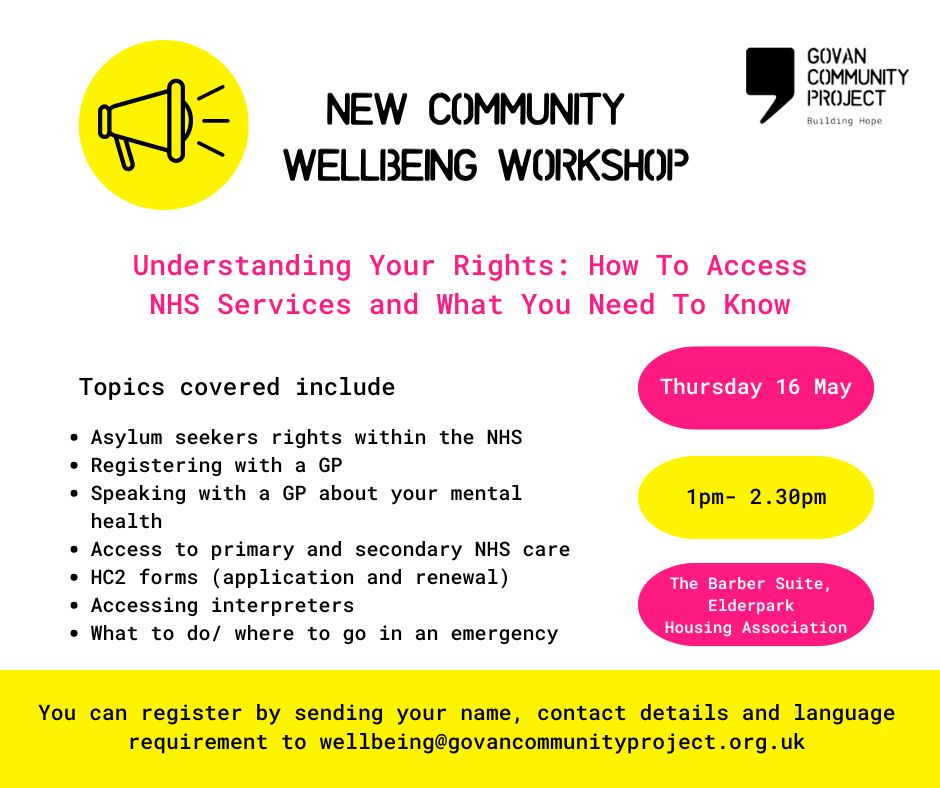
GCP is launching a series of Community Wellbeing Workshops with a focus on mental health literacy. The first workshop is How to Access NHS Services, including information on registering with a GP, accessing an interpreter for appointments and what to do in an emergency.
The workshop will be led by Francine Bucumi from the Asylum Health Bridging Team. Drawing on her personal and professional experience, Francine will talk about the importance of knowing your rights to medical treatment and how to access mental health services within the NHS.
She will also talk about the importance of social activity on the impact of mental wellbeing and share her experience of volunteering.
Topics covered in the workshop include:
- HC2 forms (application and renewal)
- Access to primary and secondary NHS care
- Registering with a GP
- Speaking with a GP about your mental health
- Accessing interpreters for NHS appointments
- Asylum seekers rights within the NHS
- Importance of social activity on wellbeing
- What to do/ where to go in an emergency
The workshop will take place on Thursday 16 May, 1pm-2.30pm at The Barber Suite, Elderpark Housing Association.
All workshops are open to anyone in the community who would like to learn more about mental wellbeing, but the support focus is on refugees and asylum seekers.
Workshops are free to attend, light refreshments will be provided, interpreters and translated materials are available upon request.
You can register by sending your name, contact details and language requirement to wellbeing@govancommunityproject.org.uk.
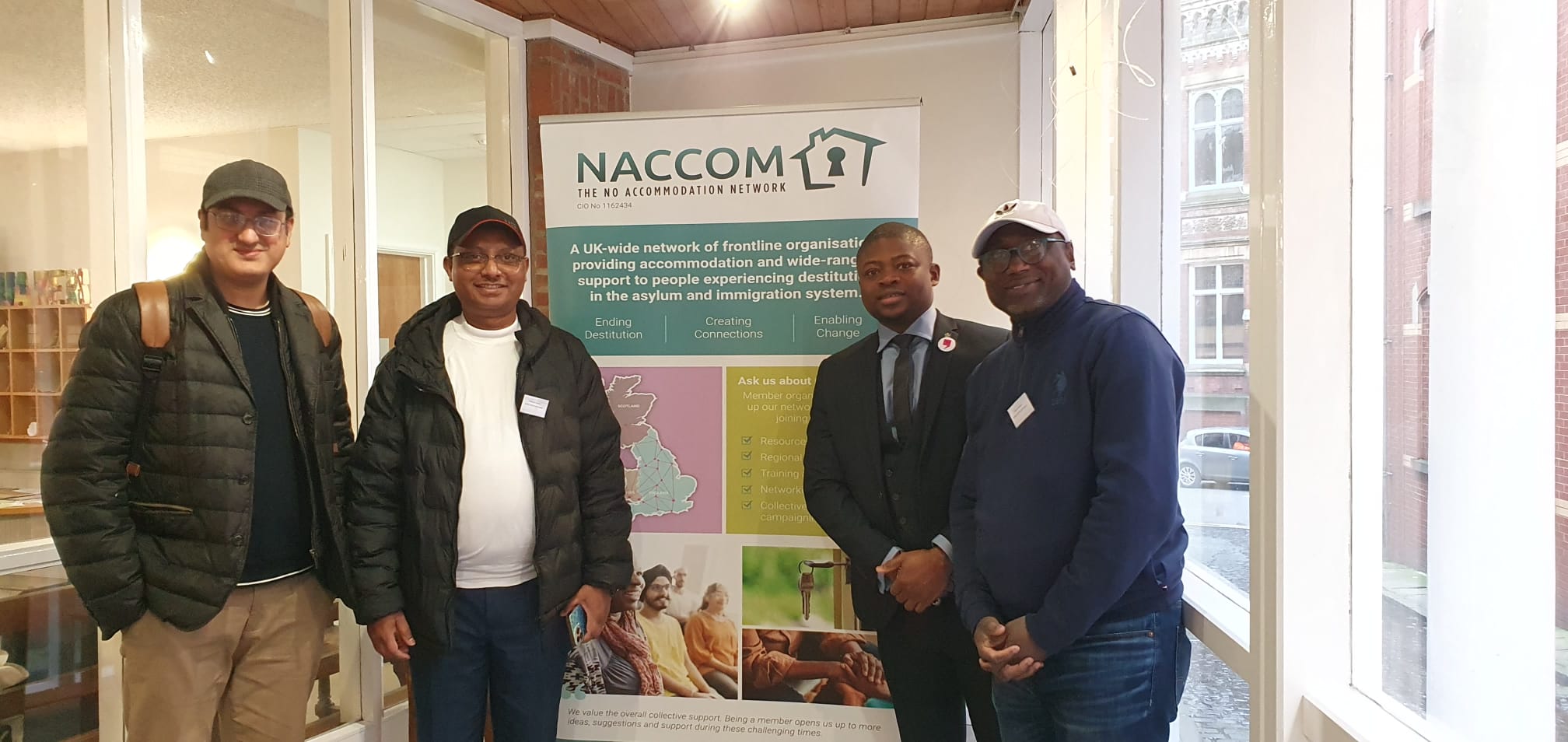
In March, GCP staff and members of our Ending Destitution Together Group attended the No Accommodation Network (NACCOM) annual conference, which promotes shared learning and good practice amongst members.
The Guardian’s Social Policy Editor, Patrick Butler, was the keynote speaker who talked about the current political and media context surrounding refugee and migration issues. He discussed the important role journalism can play in highlighting injustice and inequality and promoting compassion instead of hostility.
Other speakers included Reneae Mann, from the Refugee Council, Eiri Ohtani from Right to Remain, and Sonia Lenegan, Editor of Free Movement and asylum and public law solicitor. Participants had the opportunity to take part in workshops on themes such as setting up and diversifying housing models, working with people with complex needs, setting up and running lodgings schemes for newly granted refugees , safeguarding support in storytelling and working with the media, influencing in a general election year and building lived experience representation.
Wellbeing was a large feature of the day with all participants enjoying some amazing food and taking part in various mindfulness activities throughout the day.
We asked our group members to tell us the key things they took away from the conference:
● Importance of raising awareness/education
● The power in tackling challenges together
● No one deserves to be homeless, humanity and collaboration is so important
● Planning, mitigation and advocacy are key factors for influencing change
Feedback from our group members on their attendance was very positive and they felt the quality of the keynote speakers was very high.
One group member said: “It was a good experience to attend this kind of conference for the first time outside of Scotland. It was good from a learning point of view, to understand housing issues and case studies. Very practical approaches and we made good relationships with other organisations.”
The UK Government has passed the Rwanda Safety Bill, below is a statement from Govan Community Project in response to this:
We are absolutely devastated and disgusted at the passing of the Rwanda Safety Bill in Parliament. This enables our government to completely ignore human rights and break international law. Despite being ruled by the Supreme Court as unsafe, our uncaring government will forcibly remove people seeking asylum, including children, to a country where they are at serious risk of harm and abuse.
Time and time again, research on the views of the public show that this is not what the majority of the UK population wants. Communities up and down the UK provide a welcoming, safe space for refugees and recognise the value diversity brings to our society.
Instead of this cruel, heartless, ineffective and costly scheme, we stand in solidarity together with refugees and our colleagues across the sector and call for a new plan that recognises and respects human rights and treats everyone fairly and kindly.
We call on all of our friends, neighbours and colleagues across the country to continue to call out the UK Government on their inhumane, harmful policies.
Govan Community Project has signed a letter to the Prime Minister, along with over 250 other organisations, to express our outrage at this law. Read the letter here.
Next month Govan Community Project will host it’s first fundraising event of 2024. Back to the 80’s is a night of live music, dance and a charity raffle to raise vital funds to support refugees in Glasgow.
The event, which will take place at Fairfield Club in Govan on Friday 10 May, is set to feature live music from The Moonlighters who will perform classic hits from the 80’s. The evening will continue with a buffet and a DJ.
Megan Johnson, GCP Fundraiser, said: “Community support is essential to our work. Every penny we raise helps us to support people who have very little or, in some cases, face destitution and homelessness. This event will be a fun space for us to come together in community spirit as well as for some dancing, food and an opportunity to win some wonderful raffle prizes, which have been kindly donated by businesses in our community.”
Tickets are £10, there is also a £15 option which includes a donation. Pay-it-forward option is also available to buy a ticket for someone on low/no income.

Since 2020 the Food For All group, in collaboration with Nourish Scotland , has worked on the Dignity in Practice Project with funding from the Scottish Government’s Fair Food Fund. One participant – Aaliyah* – has been an integral part of the group for several years and has facilitated workshops, co-designed resource materials and supported other group members throughout the duration of the project.
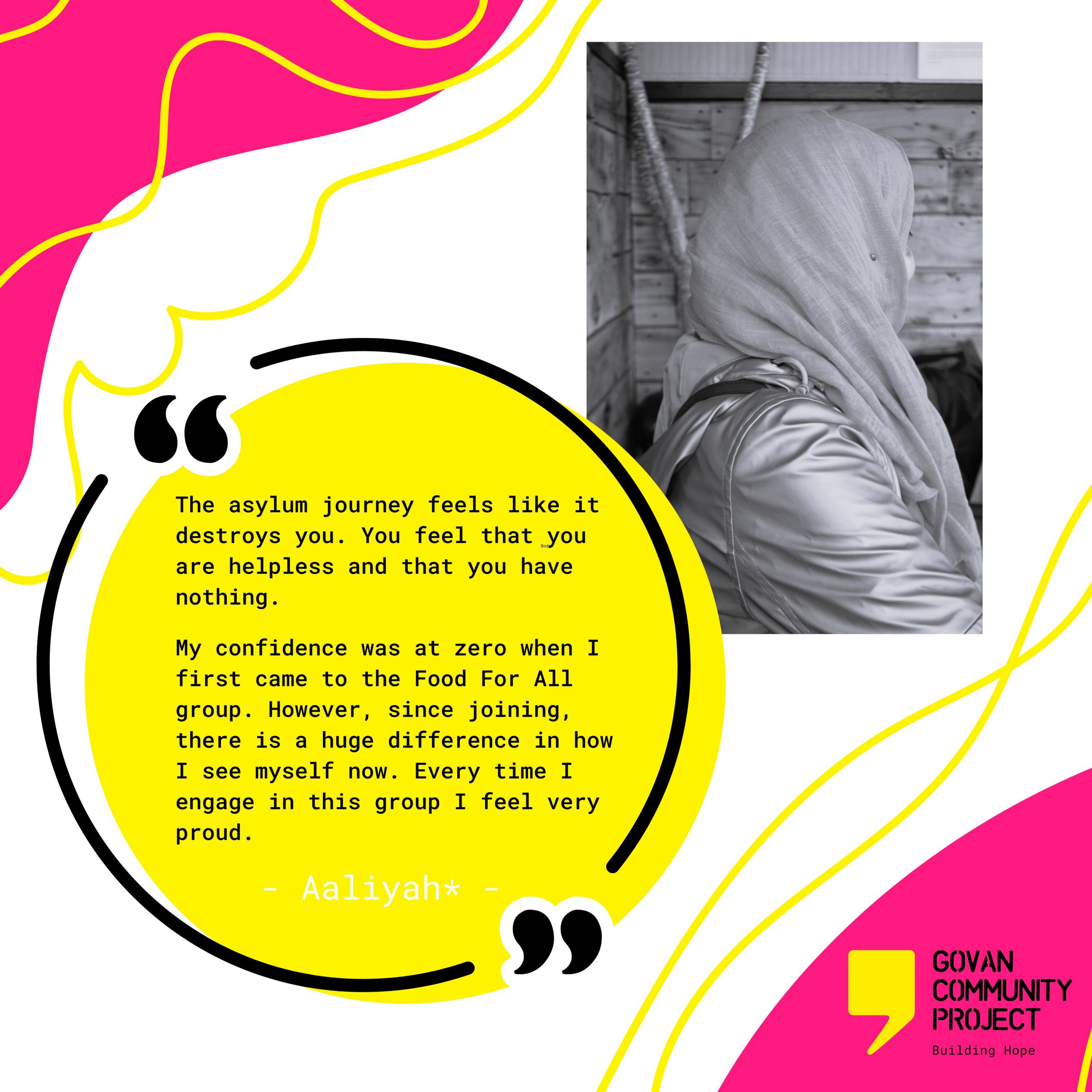
Reflecting on the positive difference that the group has made on her life in Glasgow, Aaliyah recalled: “My confidence was at zero when I first came to the Food For All (FFA) group. However, since joining the group, there is a huge difference in how I see myself now. Every time I engage in this group I feel very proud.”
The asylum journey is incredibly gruelling and undignified. Thinking back to her life a few years ago, Aaliyah said: “The asylum journey feels like it destroys you. You feel that you are helpless and that you have nothing. You feel like you are nothing because you are not able to contribute to anything.”
Despite feeling in despair about her journey through the asylum process, Aaliyah decided to join the FFA group. She told us about the many conflicting emotions she felt at the time. “I was very nervous because there were a lot of things I couldn’t do. How could I speak in front of a group of people when my English was not good? I was not well connected in the community. I was not feeling very confident.”
Aaliyah was attending a number of different community groups at the time she joined FFA, sharing stories of the asylum process. The FFA group is the one group that Aaliyah connected with the most and sees herself continuing with.
“All the other groups felt temporary. You can go and spend an afternoon there having tea, but once their funding is gone then there is no impact. I am [now] out of the asylum process, but I am still stuck there because this was my journey. My friends are still in the asylum process and they are still struggling. Because they are struggling, I am struggling, because I can feel their pain. I haven’t heard from those groups in a long time, however the FFA group is still going strong and it makes me feel like we are bringing about change.”
Aaliyah said the FFA group has had an overwhelmingly positive impact on her confidence. “Since joining the group I now feel such a change and when I am presenting in front of a big group I realise how far I have come. I had the feeling before that ‘no one listens to asylum seekers’ and that ‘the response has been very bad’. However, with the Food For All Group, the last workshop that we did face to face, I really felt that people do want to learn more about the asylum journey and how people are struggling.”
The importance of sharing space with other people who have been through the asylum process is very important to Aaliyah. The success of the FFA group is evident through the strong support that the group members provide to each other. Aaliyah told us she feels 100% supported by the group both in sessions and also when delivering workshops.
She added: “The FFA group is a strong, and unique team because the group is comprised of members with different, individual personalities; this makes us a great team. When I joined this group, I remember I was a bit shy and I wanted to say something. Sara was in the same journey as me and I was stuck with my words and she came in and she knew what I was trying to say, she helped me to find the right words to say it. I felt very grateful that she knew what I was thinking. It makes you feel that you are not alone. You are in a group of people that understand you. They see you.”
Aaliyah is hoping to see positive change for herself, the group members and the whole asylum system.
*Name changed to protect anonymity
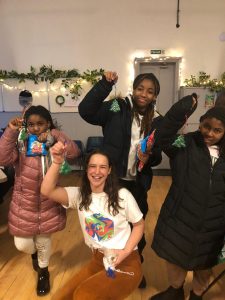
December is always a busy month for our Homework Club, with lots of festive activities taking place.
Kezia, Homework Club Project Lead, explains a bit more about what the kids got up to over the festive season and shares some exciting news they’ve received in the new year.
“In December our high school attendees were busy revising for prelims, while the primary school attendees enjoyed the winding down of homework from school, which means more time for crafts, games and fun. We recently got an old Nintendo Wii console, and while the kids thought this was pretty retro (we got some eye rolls at first) everyone has had great fun with it. Some classics never go out of style!
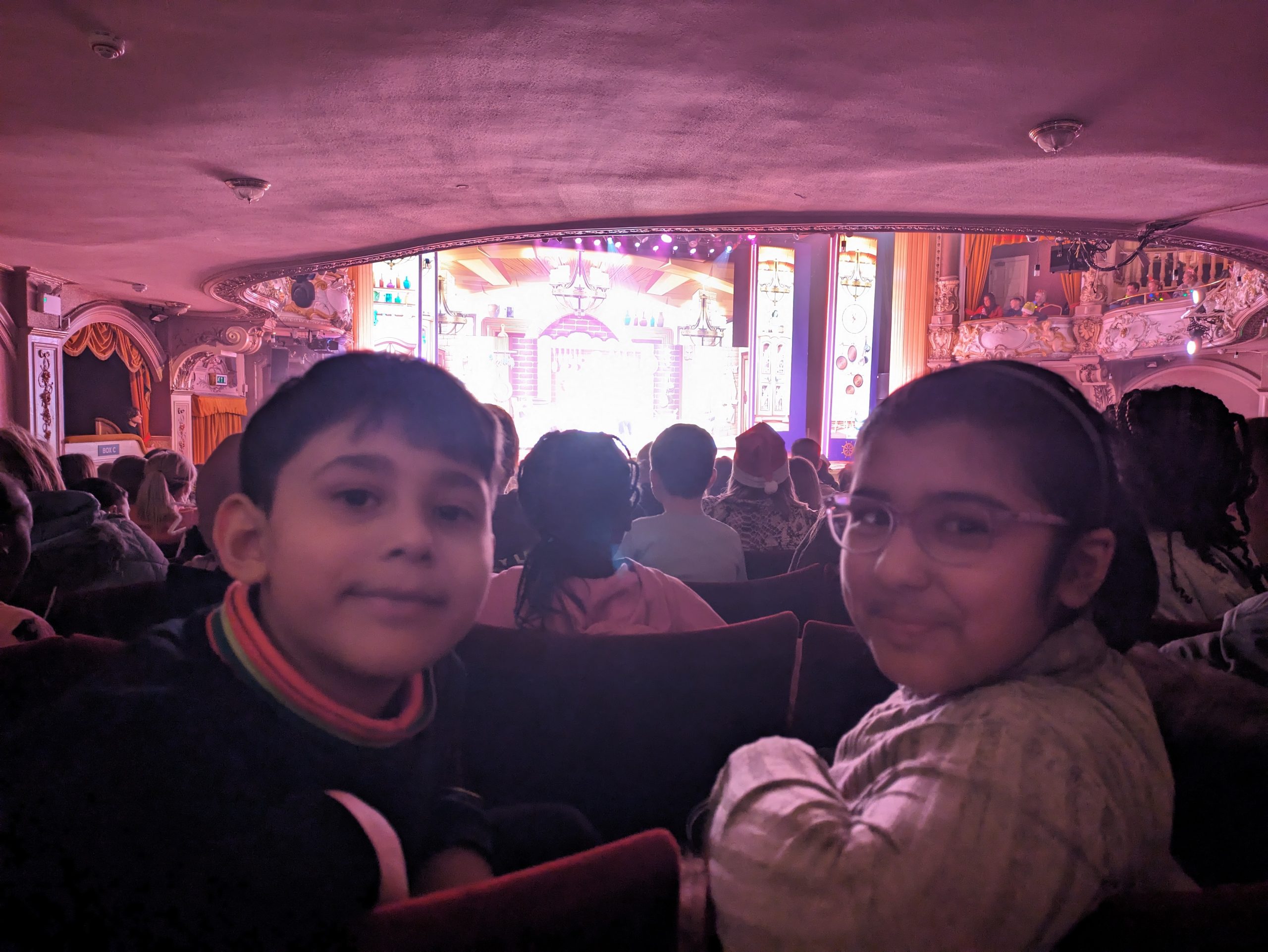
It was lovely to see some of our Homework Club attendees and their families attend the GCP Christmas
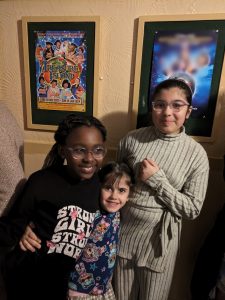
Party in Govan too. It’s always good to meet parents and other GCP community members outside of our project. We ended the year with back-to-back fun, with a Christmas party with games and extra snacks on the last Monday session of the year, before an extra special trip to the Pantomime at the Pavilion Theatre on the Tuesday. The Panto trip is always a highlight! We were especially grateful to receive funding from Safe Deposit Scotland Community Fund, which financially supported us to take the 28 kids and teens, and six staff and volunteers along to the Panto. Thank you for supporting our work.
A special mention to Glasgow Spirit of Christmas, who we partnered again with this year. They do incredible work to make sure every child in Glasgow can wake up on Christmas day with presents from Santa, and experience the magic of Christmas.
Our staff and volunteers then enjoyed well-earned time off. The winter holidays are the only school holidays that aren’t filled with extra activities and trips, giving staff and volunteers time to rest, relax, and enjoy time with loved ones.
Homework Club started back on 17 January 2024 (despite some eager faces showing up two days before…sorry for turning you away, we love the enthusiasm!). We have dived straight into busy homework schedules, but will always find time for a couple of games of Uno and some drawing.
We are also very excited to share that we started 2024 with some special news.
The Homework Club has been awarded funding by the Orp Foundation, which has increased staff capacity across the team, and will allow us to develop the project. What a way to start the year!”